A green banner that stretched above an entrance to Holladay Park in downtown Portland marked the finish line, the final pedal strokes of a two-day, 207-mile journey that in hindsight was much more rewarding than I had ever anticipated.
Spectators at the end of the Seattle to Portland Bicycle Classic (STP) - families, event staff, and volunteers - lined each side of the fenced chute clanging cowbells, waving signs, and cheering each arrival. They didn’t know me, yet their encouragement was emotionally moving. It was also validating.
I spoke with many bicyclists during this July weekend. Several were newcomers like me. Others were riding their 8th, 15th, even 28th STP. Completing the route was an achievement, yet everyone seemed equally committed to the camaraderie, the idea that more than 6,000 people could do this together.
And in the process, I’ve joined their ranks.
Since my return, friends have been asking questions. Some are already thinking about STP 2027. Here’s what I’m saying.
Degree of Difficulty
Organizers told me months ago that my biggest concerns would be my “mind and behind.” The mental aspect proved inconsequential and while my butt hurt, it was tolerable when I found ways to distract myself. Time and miles clipped by, perhaps because I was focused on my ride strategy.
Little was said about the endurance required to ride 102 miles from Seattle to Centralia one day and pedaling another 105 to Portland the next day. Even less was mentioned about elevation gain measured at 2,217 feet on Day 1 and 2,631 on Day 2, according to RidewithGPS.com.
That doesn’t seem like much when spread across so many miles. Still, there are hills to address. The most notable may be at mile marker 44: Puyallup Hill, 2.3 miles with 400 feet of gain. I was psychologically prepared after researching the road using Google Street View. I knew the first crest was not the last crest and when others audibly moaned as the road continued to tilt up, I was mentally geared for more.
There were many other small hills; this was not a flat route. But for every climb up there’s a glide down.
A Meal and a Good Night’s Rest
While some riders completed the full distance in one day, most stopped somewhere near Centralia. Food trucks at Centralia College, the official midway point, provided pay-as-you-go sustenance. A celebratory Day 1 drink was purchased at the adjacent beer garden.
Overnight bags, trucked in from Seattle, were retrieved. Some riders slept in tents, others found space on nearby church and school floors. I booked a hotel room a mile from the college campus. With a good night’s sleep, my bag was back on the truck by 5:30 a.m. and I was rolling again.
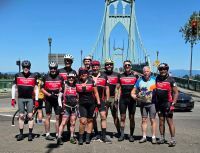
The Gruppettos
My ride strategy focused on survival. Don’t push too hard and average 10 miles each hour factoring in rest stops. It was a good plan. Faster speeds, drafting opportunities, downhills, and my better-than-anticipated fitness allowed more time to relax at each stop. I was on pace.
This strategy, however, precluded much social intersection.
I was riding alone, but I had the Gruppettos.
In Italian, gruppetto translates to small group. Those familiar with professional cycling know that a gruppetto, also called an autobus, is a cluster of riders who have fallen off the peloton and decide to ride together to the finish line.
Here in Seattle, it means the Gruppetto Cycling Club, friends and family with a shared love of bikes. Gabe Castillo, founder and organizer of this merry band, invited me to join 11 members and ride out of town together. We met at 5 a.m. in a University of Washington parking lot and enjoyed a peaceful start.
I had opportunities to ride with them throughout the weekend, but I let them pull away as I stayed with my plan. Along the way, however, I discovered that the Gruppettos had their own independent rest stops. I sought out the Gruppetto banner flapping in the breeze at each stop and enjoyed their lavish tailgate-style aid stations. Mimi Castillo, Gabe’s sister, and friends have been providing this road support since 2007.
“Over the years, our support team has spoiled us,” Gabe told me. “I have encouraged Mimi to take it down a notch or two when it comes to food and amenities, but she keeps doing it. It’s in her DNA.”
The Gruppettos were not alone. Several groups set up their own rest stops. One club even travels with its own SAG wagon stocked with hydration, food, and spare parts.
Imagine a cold, soaked towel placed on your head during a warm afternoon break and a table spread with food to fuel the rest of the day’s ride. I began looking forward to the Gruppetto stops and what Mimi had prepared for us.
The Home Stretch
A long ribbon of riders left the city of Longview, crossed the steel cantilever Lewis and Clark Bridge over the Columbia River, and began the final 52-mile march to downtown Portland, the Rose City. The first 43 miles followed U.S. 30, a roller coaster of rises and dips that tested a cyclist’s patience more than the legs.
Highway 30 is a major travel corridor between coastal communities and the metro area, and while I was leery about riding on the road shoulder, I eventually became oblivious to passing cars and trucks. Motorists kept to the far-left lane, for the most part, while I stayed on the shoulder. Passing other bikes became routine. Check my mirror. Wait for a safe opening. Shout “passing on your left” and go.
It all became routine, and I was surprised to suddenly arrive at Portland’s St. Johns Bridge. One more river crossing and the end was only 9 miles away.
Would I Do It Again?
Yes.
Set aside for a moment the personal accomplishment, the satisfaction of achieving what I once thought was impossible. The Seattle to Portland Bicycle Classic is not designed to be ridden in relative solitude. This is best experienced with others.
Perhaps next year.